What Do You Want to Spend Your Life-Energy On? | Capacity in Midlife
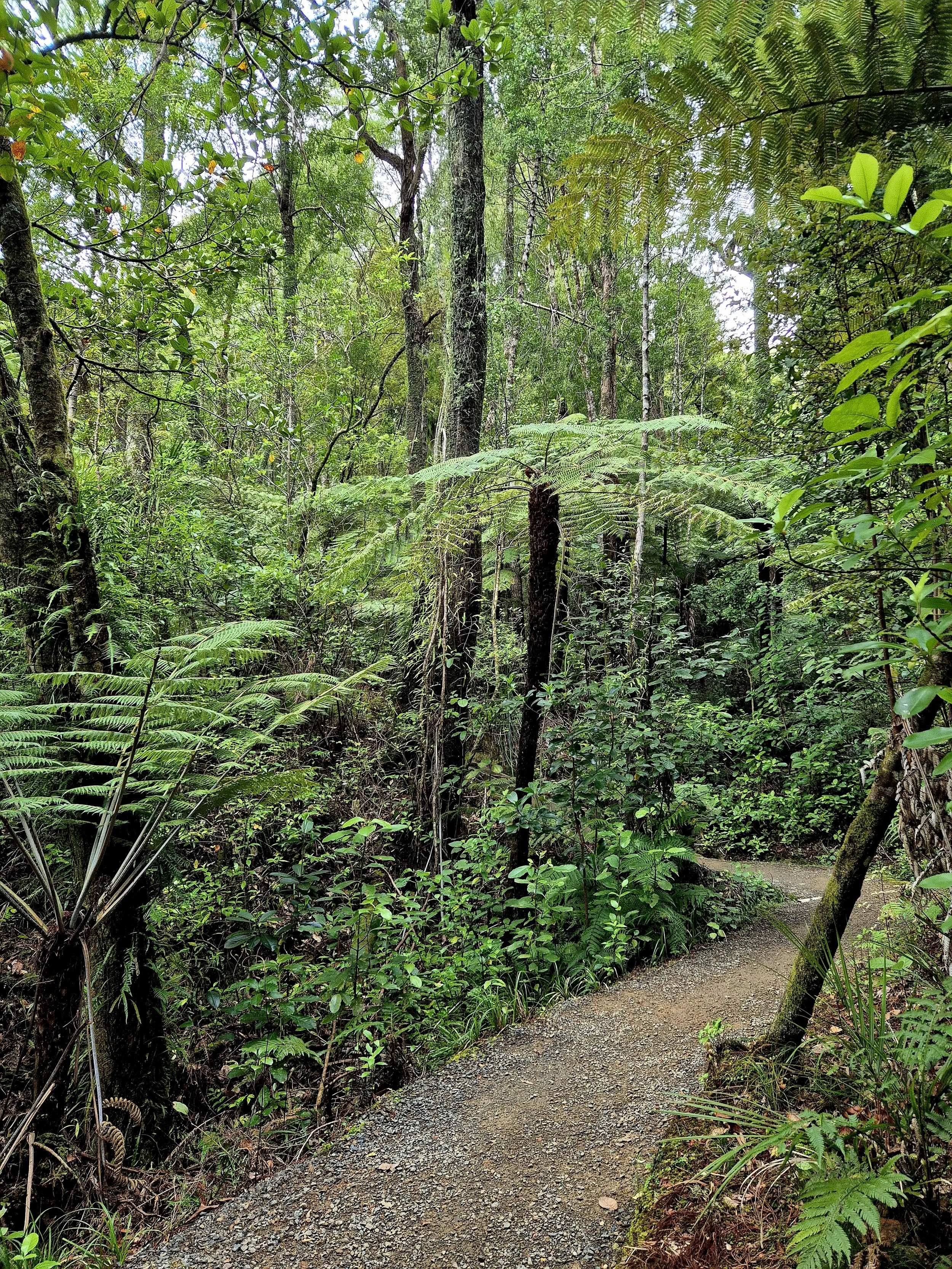
Winding up through the native bush on Parihaka — a reminder that how we choose to spend our energy matters as much as how much we have.
I have been circling a question lately that, at first, sounds like a question about energy management.
It isn’t, really.
Or at least, not in the way we usually talk about energy — as though it were simply another resource to optimise so we can become more efficient, get more done, and somehow squeeze a little more productivity out of the day.
The question I keep coming back to is much more personal than that:
What do I actually want to spend my life-energy on?

How We Spend Our Energy In Midlife
Over the school holidays, with hubby at home, I found myself thinking about this question in a rather more ordinary way.
We had plenty to do. Our campervan needed work to prepare it for sale, and I had all sorts of plans taking shape in the new gardens — beds to establish, plants to move, things to clear and build and gradually turn into the garden I can already see in my head. Given half a chance, I could have happily spent days disappearing into it all.
But those weren't the only things I wanted the holidays to contain.
I wanted walks with hubby and Gizmo, our little dog. I wanted us to go off and do things simply because they sounded fun. I wanted time in the garden because I love being there, not because I had turned the whole property into another enormous project with an invisible completion date. And I wanted afternoons when we could sit down, read, potter, have a cup of tea, or do absolutely nothing useful at all.
The interesting part was that, on many of those days, I was perfectly capable of doing more.
I almost always had another job I could tackle, another useful thing I could have squeezed into the day. However, asking whether I still have enough energy to do one more thing isn't quite the same as asking whether I want to spend that energy on it.
So some days we worked hard physically, and on others we walked or went somewhere together, and I stopped while plenty was still unfinished.
The point wasn't to ration every scrap of energy or organise the holidays into some beautifully balanced schedule — I simply wanted to let the things we wanted to experience claim their share of the available capacity too.
I changed the allocation, and I think that distinction matters.
What Do I Want My Capacity to Be For?
People often discuss capacity as though the only useful question is how much of it we have. How full is the tank? How large is the energy envelope? What can we fit inside it before we reach empty?
But increasingly I think there is another question sitting alongside that one:
What do I want my capacity to be for?
I had a similar conversation with a friend.
She had already had a busy day and was facing a three-hour round trip to run an errand for someone — an hour and a half there, an hour and a half back — before turning around the following day and driving another long way.
She could do it, but did she actually need to?
Once we started pulling apart the assumption that she had to make the trip herself, other possibilities appeared. Turns out, she didn’t need to physically be the one to do it, which left her at home to have lunch, listen to the tūī in the trees, attend to some pressing office work, and avoid spending three hours of her available energy behind a steering wheel.
Again, the interesting question was not whether she was capable; it was whether the demand deserved that much of her.
I wonder how often those two questions have become confused for many of us.
Can I do this?
Do I want to spend my energy doing this?
They are not the same question.
When Being Capable Becomes an Obligation
For much of my life, if the answer to the first question was yes, that was usually enough. If I could cope, I coped. If I could fit something in, I did. If I could help, organise, solve, carry, lead, push through, take on the next project, or somehow make the whole thing work, then being technically capable often became the reason I did.
Being capable is a strange trap.
Other people learn that you can carry a great deal, but perhaps more importantly, you learn it too, and then capacity quietly becomes obligation.
Midlife, Menopause and Changing Capacity
Midlife has complicated that for me because my available energy has changed.
Moving through into menopause has coincided with a very noticeable change in my energy. I have friends in their mid- and late-fifties who talk about the same frustration: we remember bodies that seemed able to carry an extraordinary amount.
That experience also sits comfortably alongside the evidence: fatigue is recognised as a common symptom of menopause. So while every woman’s experience is different, the shift in energy that my friends and I talk about is hardly unusual.
I used to work for hours in the garden, walk the dog, prepare food, practise yoga, and handle work and household demands, and expect, more or less, to get up the next day and do it all again. I said yes to everything and, as a result, often found myself far too overloaded, and eventually burnt out.
But here’s the thing: I cannot organise my life around that remembered capacity anymore, and perhaps one of the harder parts is that our expectations don't automatically change just because our bodies do.
We can keep measuring ourselves against an earlier version and interpreting the difference as a problem to solve. Get fitter. Build more stamina. Improve the diet. Sleep better. Try harder. Recover faster.
Sometimes those things may help, and I’m certainly still interested in being fit, strong, and well enough to do the things I love.
However, I'm becoming less interested in using every available scrap of energy to recreate the capacity I once had.
The body I have now is the one actually living this life, and if its capacity is finite, then allocation starts to matter enormously.
The Hidden Energy Cost of Pressure
I’ve also noticed another aspect of this: sometimes what consumes capacity isn't the task itself, but the pressure wrapped around it.
There is the tiredness, the unfinished job, the changed body, the afternoon already full, and then there is the second layer: the “shoulds.” I should be able to do more. I should finish this today. I should be keeping up. I should be different from how I am.
None of that makes the original reality disappear, but I have started to wonder how much energy I have spent not only living my life, but arguing with it.
Perhaps accepting the capacity I have today isn't giving up on growth; maybe it means I don't have to make the present unacceptable to be interested in what comes next.
Not All Energy Costs the Same
Not all energy expenditure is physical, either.
Some things cost very little physically and an enormous amount mentally. A difficult email can take minutes to answer and churn in the background of the mind for hours, and a room full of people can be physically easy to sit in but deeply draining for a highly sensitive nervous system.
Emotional labour, uncertainty, decision-making, sensory input, worry, responsibility, conflict, planning, and constant cognitive processing all draw from us in ways that are harder to see than a long walk or, in my case, an afternoon of shifting bricks.
Other things can be physically demanding and strangely restorative.
I can be gardening until I’m pleasantly tired but mentally clearer. A walk through the bush may use physical energy while giving something back elsewhere, and creative work can leave my brain tired and still feel deeply worthwhile because it matters to me.
So perhaps an energy budget is too crude a metaphor on its own.
We are not only asking how much an activity costs. We are also asking what kind of energy it uses, what it gives back, what else is already sitting in The Stack, and whether this particular expenditure matters enough to deserve its place today.
What Does Sustaining This Leave Less Room For?
Sometimes that question is about one afternoon, and sometimes it’s about a life.
Other friends have spent years in extraordinarily demanding professional roles. They’re great at it, have worked incredibly hard, and have now reached a point where almost all of their available energy goes into the job. Very little is left for anything else.
Time away from work offers a different perspective, and many have begun to question: Do I actually want this anymore?
Not: Can I keep doing it?
The question is no longer simply whether they can.
When you have enough resources to choose differently — whether financially or in the alternative opportunities available — the question can become: Does this particular role still deserve such a large proportion of your remaining life-energy?
I find that question enormously powerful because it moves capacity away from simple conservation.
It also makes me think about what sustained allocation leaves less room for. Even when we can keep carrying something — a job, a responsibility, a household role, an endless stream of things that somehow became ours — the cost isn’t measured only in exhaustion. It can also be the attention, creativity, friendship, solitude, play, wandering, or rest that never gets first claim on us.
When Self-Care Isn’t the Whole Answer
Not every energy problem can be solved by becoming better at self-care. Sometimes the useful question is what would support me within the life I have, and other times, whether something about that life's structure needs to change.
Some responsibilities are fixed, some are constrained by money, work, caregiving or circumstance, and some have simply become ours by default. We do not all have equal freedom to rearrange them, but making the allocation visible can at least help us see where genuine choice exists.
Choosing What Deserves Your Life-Energy
This is not about making our lives smaller because we fear running out of energy.
It is not about protecting ourselves from every demand, refusing every difficult thing, or treating tiredness as evidence we should withdraw from the world — frankly, my high sensation-seeking self would find that unbearable anyway.
I want challenge. I want creativity. I want gardens and walking and ideas and projects and people and the things that stretch me beyond what is comfortable.
I also want more choice about what gets to stretch me, and perhaps that is the deeper shift.
Instead of asking only, What am I capable of carrying? I can begin asking, What deserves to be carried by me?
Instead of automatically assuming an incoming demand outranks whatever else my nervous system is holding, I can ask whether it’s urgent, whether it’s mine, whether it needs to happen this way, and whether I actually want to spend the energy it will consume there.
I'm adding another question to that list now: even if I can sustain this, what does sustaining it leave less room for?
I don't want to recover or protect capacity simply to hand every scrap of it straight back to the same demands that consumed it. I want to leave some of it for the things that make a life feel inhabited rather than merely managed.
Enoughness: When Capacity Stops Being Proof
And perhaps this is also part of enoughness.
If I no longer have to prove my worth through how much I can do, how much I can carry, how well I can cope, or how relentlessly I can improve myself, then capacity stops being evidence for the defence.
It becomes something much more precious — it becomes part of a life I am allowed to choose.
I am still learning what that means in practice, and sometimes I will undoubtedly overdo it and discover it afterward. Sometimes I will underestimate myself, and sometimes I will choose the physically harder thing because it gives me joy. Sometimes I abandon a perfectly sensible plan because my body tells me today isn't the day.
Dynamic Balance was never going to mean getting every allocation right; it means becoming more aware of the exchange.
What is this asking of me?
What is it giving back?
What else am I already carrying?
And, underneath all of that: Do I actually want to spend part of my finite life-energy here?
That question feels very different from trying to squeeze more out of myself — it feels more like deciding what I want my life to contain.
If this question has struck a chord, you might like to stay in touch. I write the A Balanced Life blog for women navigating midlife, changing capacity, and the sometimes contradictory needs of a sensitive, curious nervous system. Once a month, I share a new reflection and practical perspective on creating a life that supports the person living it. Join the A Balanced Life email community below.
I took this question with me on a walk up Parihaka this morning. It seemed a rather fitting place to reflect on life-energy while deliberately spending quite a lot of it climbing a steep hill! In this short video, I explore the difference between being tired from something we genuinely choose to do and feeling depleted by the things we've simply become accustomed to carrying.
Choosing how to spend my life-energy — reflections from a morning hike on Parihaka, Whangārei.
